
Relocating to Central Florida in 2026: The Honest Guide
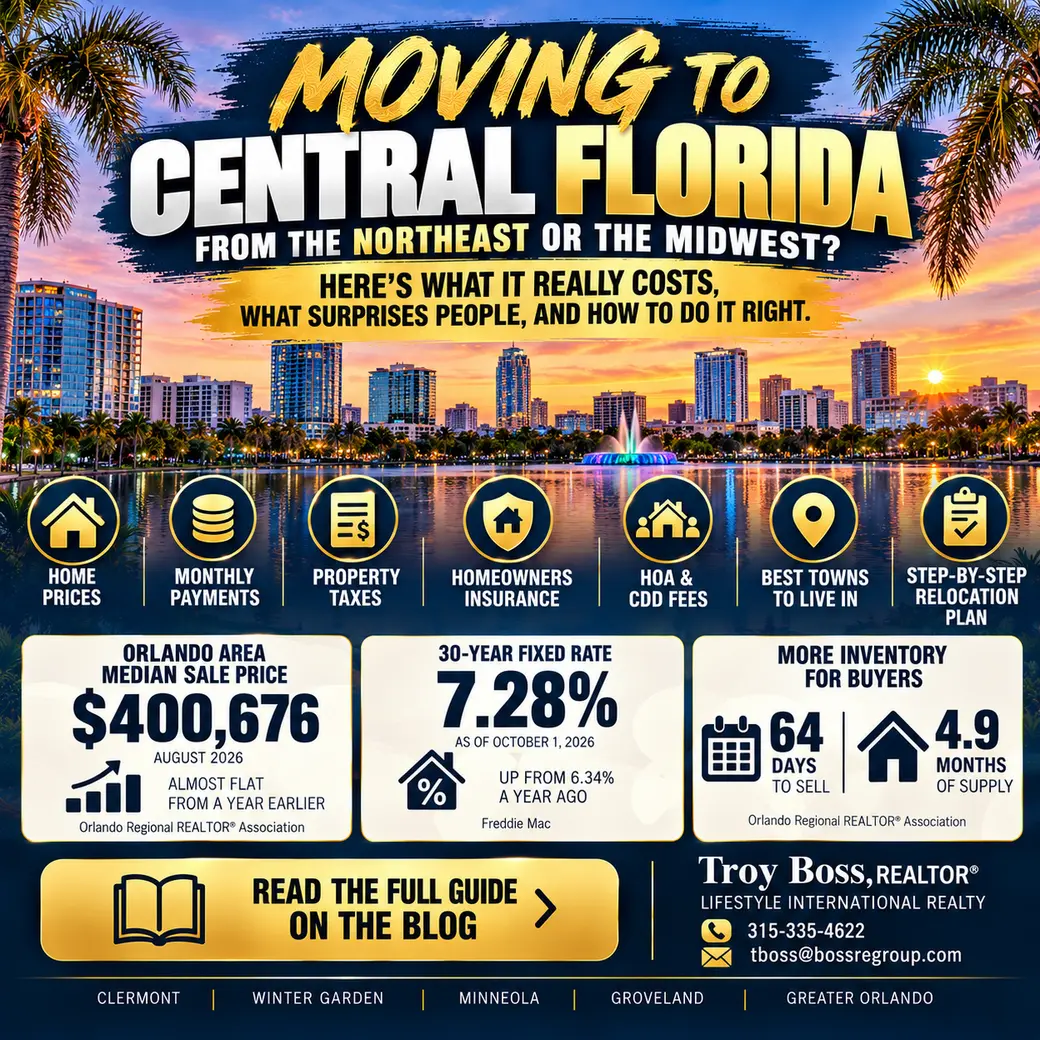
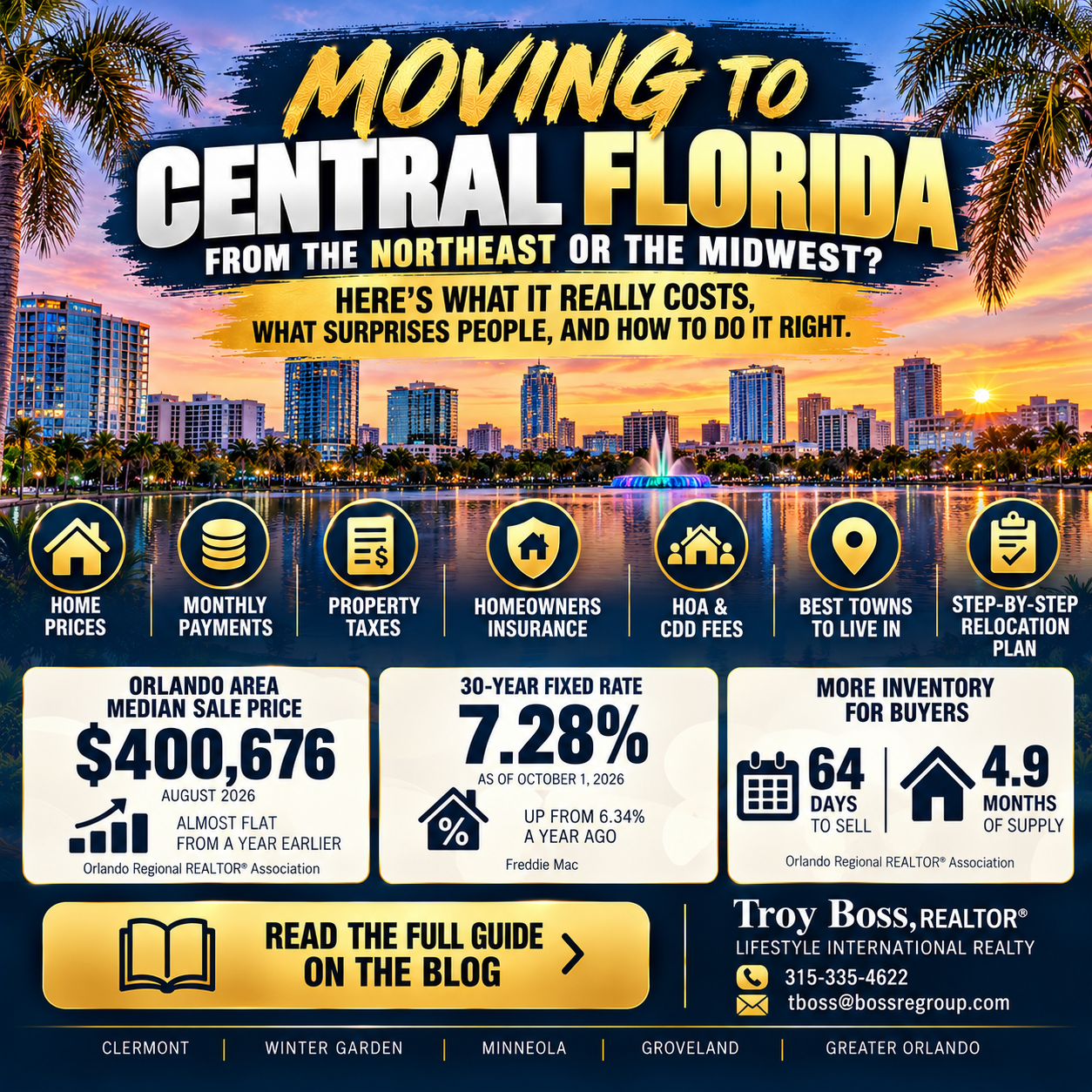 If you're thinking about moving to the Orlando area from the Northeast or the Midwest, you've probably read a dozen articles that make it sound like a postcard. This one is the version I'd give a friend. I'm Troy Boss, a REALTOR® with LIFESTYLE International Realty in Clermont, and I still carry an upstate New York phone number, so I know the move you're weighing. Here's what it really costs, what surprises people, and how to do it in the right order.
What does a home cost in Central Florida right now?
The Orlando-area median sale price was $400,676 in August 2026, almost flat from a year earlier, according to the Orlando Regional REALTOR® Association. Single-family homes had a median of $436,456. Condos and townhomes came in at $301,071. Homes took a median of 64 days to sell, and there were 4.9 months of supply, which gives buyers more room to negotiate than they've had in years.
Clermont runs a little higher than the metro: the median was about $460,000 in July 2026 (Houzeo). Winter Garden is typically higher still. Groveland and Minneola usually come in lower, with a lot of new construction.
What will the monthly payment really be?
The 30-year fixed rate averaged 7.28% in Freddie Mac's survey of October 1, 2026, up from 6.34% a year ago. Here is principal and interest only, with 20% down, at that rate:
| Home price | Loan (20% down) | Principal + interest |
|---|---|---|
| $400,676 (metro median) | $320,541 | $2,193 / month |
| $460,000 (Clermont median) | $368,000 | $2,518 / month |
| $700,000 | $560,000 | $3,832 / month |
That number is only the start. Four more lines decide whether a Florida home fits your budget, and they are the ones people moving from out of state miss:
- Property taxes. Estimate them on your purchase price, not on the seller's current bill. More on that below.
- Homeowners insurance. Get a real quote on the specific house before you make an offer.
- HOA dues. Common in newer communities, and they vary widely.
- CDD fees. A bond payment on many newer communities that shows up on the tax bill.
Does no state income tax really save money?
Florida has no state personal income tax. For a household coming from a state that taxes income at 5% or more, that can be thousands of dollars a year. As a simple illustration, 5% of $200,000 in taxable income is $10,000. Your real number depends on your income, your deductions and the state you're leaving, so run it with your CPA before you count on it. I'll break this down in next week's guide.
What should I expect for homeowners insurance?
This is the line that surprises people most, and it varies more from house to house here than it does up north. Three things move the price: the age of the roof, the year the home was built, and whether it has wind-mitigation features such as roof straps and impact-rated openings. Newer homes inland usually quote much lower than older homes or homes near the coast. My rule: get an insurance quote during your inspection period at the latest, and before the offer if you can. Ask for the wind-mitigation and four-point inspection reports on any older home.
What are HOA and CDD fees?
An HOA fee pays for the community's shared amenities and upkeep. A CDD fee repays the bonds that built the roads, utilities and amenities in many newer communities, and it's billed with your property taxes. Two homes at the same price can differ by several hundred dollars a month once these are added. I wrote a full explainer here: HOA and CDD fees in Clermont new construction.
How do property taxes work for new Florida residents?
Three rules matter:
- The bill resets when you buy. A long-time owner's taxes are capped. Yours are based on a new assessment after the sale, so the seller's bill usually understates what you'll pay.
- Homestead exemption. If the home is your permanent residence, you can exempt up to $50,000 of assessed value: the first $25,000 applies to all property taxes, and a second exemption of about $25,000, adjusted yearly for inflation, applies to non-school taxes. You must apply with the county property appraiser by March 1.
- Save Our Homes. Once you have homestead, your assessed value can rise no more than 3% a year.
A proposed amendment on the November 2026 ballot would change the exemption if voters approve it. I'll update this guide after the vote. For your own numbers, use the county property appraiser's tax estimator and confirm with your tax advisor.
Which town should I look at?
Here are the facts I'd start with:
- Clermont (Lake County): about 25 miles west of downtown Orlando, known for hills and lakes, with a mix of established neighborhoods and new construction.
- Winter Garden (Orange County): just east of Clermont, with a historic downtown on the West Orange Trail and quick access to State Road 429.
- Minneola: directly north of Clermont, with its own Florida's Turnpike interchange and several large new communities.
- Groveland: west of Clermont, with more new construction at lower prices and a longer drive to Orlando.
The right answer depends on where you'll work, how often you'll fly, and how much house you want. Drive the commute at rush hour before you choose.
What order should I do this in?
- 90 days out: get pre-approved, or line up proof of funds if you're paying cash. Decide whether you need to sell first.
- 60 days out: narrow to two or three towns. Plan a two- or three-day visit and see homes in each.
- 30 to 45 days out: make the offer, then use the inspection period for the inspection, the insurance quote and the HOA documents.
- After closing: get your Florida driver's license, register to vote if you choose, and file for homestead by March 1.
Common questions
Can I buy before I sell my home up north?
Sometimes. It depends on your equity, your income and the loan. A lender can tell you in one conversation. If you'd like an introduction, I work with Frank Pugliese at Columbus Capital Lending (NMLS 1976704).
Do I have to be in Florida to close?
Usually not. Many title companies offer mail-away or remote online closings. Confirm with the title company handling your purchase.
How long does a purchase take?
A financed purchase typically closes in 30 to 45 days. Cash can close faster.
Is now a good time to buy?
Rates are higher than a year ago, and that hurts the payment. Supply is also higher and homes are taking about two months to sell, so buyers have more negotiating room on price, repairs and closing costs than they've had in a long time.
Want this mapped to your own move? I'll walk you through your budget, your towns and your timeline in 20 minutes, with no pressure.
Book a free 20-minute relocation call
Troy Boss
REALTOR® – LIFESTYLE International Realty, Clermont
315-335-4622 · tboss@bossregroup.com
Sources: Orlando Regional REALTOR® Association, August 2026 market report. Freddie Mac Primary Mortgage Market Survey, October 1, 2026. Houzeo, Clermont market data, July 2026. Florida Department of Revenue, homestead exemption (PT-113). Payment examples are principal and interest only, 30-year fixed, 20% down, and are illustrations, not loan offers. This guide is general information, not tax, legal or insurance advice. Confirm your own numbers with your CPA, attorney, lender and insurance agent.
Recent Posts








"My job is to find and attract mastery-based agents to the office, protect the culture, and make sure everyone is happy! "