
No State Income Tax: What Moving to Florida Really Saves a $200K Household
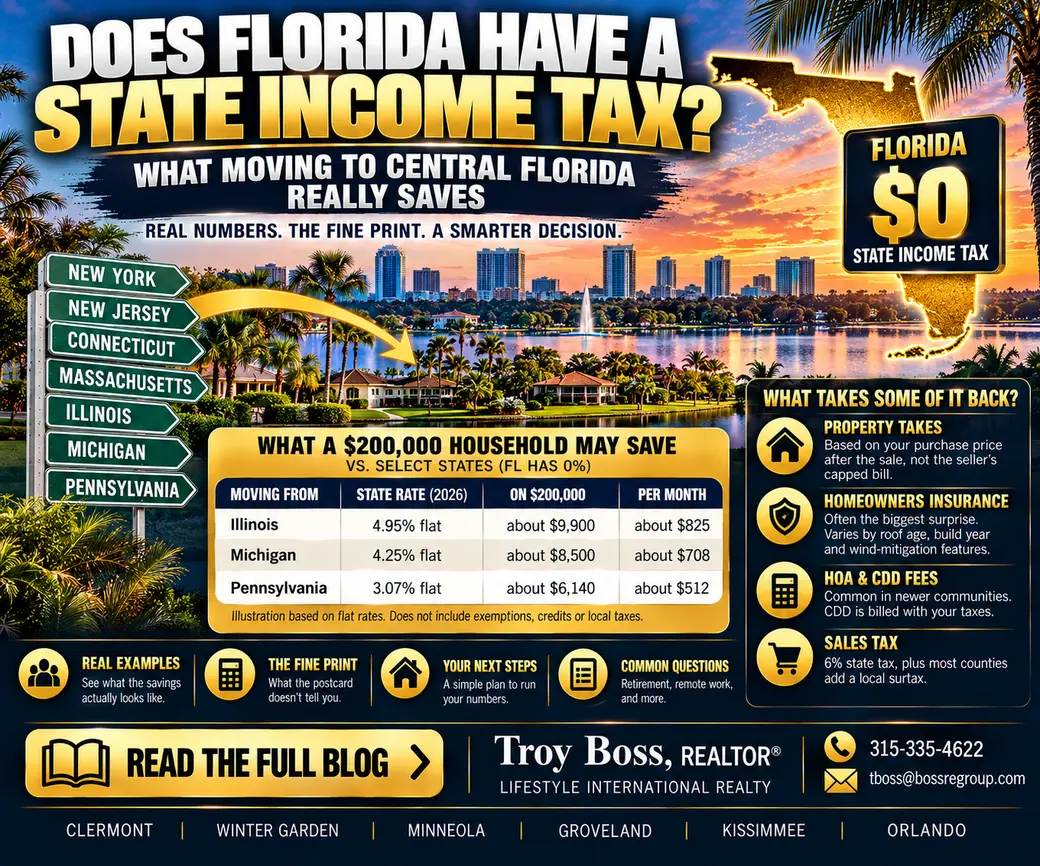
"No state income tax" is the line everyone repeats about Florida, and it's true. What nobody tells you is how much it's actually worth to a normal household, and what quietly takes some of it back. I'm Troy Boss, a REALTOR® with LIFESTYLE International Realty in Clermont, and I grew up paying New York taxes, so here is the version with real numbers and the fine print.
Does Florida really have no state income tax?
Yes. Florida does not tax wages or other personal income at the state level, and its constitution blocks a personal income tax. That also means no state tax on Social Security, pensions or retirement account withdrawals at the state level. Florida also has no state estate or inheritance tax. Confirm how each applies to you with your CPA.
What does a $200,000 household actually save?
It depends entirely on the state you're leaving. Three states charge one flat rate, which makes the math simple. Here is a rough illustration on $200,000 of taxable income, before exemptions, credits and local taxes:
| Moving from | State rate (2026) | On $200,000 | Per month |
|---|---|---|---|
| Illinois | 4.95% flat | about $9,900 | about $825 |
| Michigan | 4.25% flat | about $8,500 | about $708 |
| Pennsylvania | 3.07% flat | about $6,140 | about $512 |
New York, New Jersey, Connecticut and Massachusetts use graduated brackets. Their top rates are high (New York 10.90%, New Jersey 10.75%, Massachusetts 9.00%, Connecticut 6.99%), but a $200,000 household does not pay the top rate on every dollar, so don't multiply. Your actual number comes from your state return, and your CPA can run it in ten minutes.
What takes some of it back?
This is the part the postcard leaves out. Florida makes up some of the difference in other places:
- Property taxes. Your bill is based on your purchase price after the sale, not the seller's capped bill. Homestead exemption helps, but it does not erase it.
- Homeowners insurance. Often the biggest surprise. It varies by roof age, build year and wind-mitigation features, so get a real quote before you make an offer.
- HOA and CDD fees. Common in newer communities, and the CDD is billed with your property taxes.
- Sales tax. Florida charges a 6% state sales tax, and most counties add a local surtax on top.
Net, a household leaving a high-tax state usually still comes out ahead. A household leaving a low-tax state may find insurance and property taxes eat most of the gain. Run both sides before you decide.
Does the federal deduction change the math?
It can. If you itemize, state and local taxes (income, property and sales) are deductible on your federal return, up to a cap. For 2026 that cap is $40,400 for most filers, and it phases down for higher incomes. Because part of your old state income tax was coming back to you as a federal deduction, your true savings from moving is smaller than the headline number. Florida property taxes count toward the same cap. This is exactly the kind of detail to confirm with a tax professional.
Is moving my address enough to stop paying my old state?
Not necessarily. Your old state can still claim you if you keep a home there, spend a lot of days there, or earn income from sources there, and some states audit former residents closely. The usual advice: make Florida your real home, with a Florida driver's license, voter registration, a homestead filing on your new house, and records of where you spend your days. Then have a CPA review the year you move. I'm a REALTOR®, not a tax advisor, so treat that as a checklist of questions, not advice.
What should I do first?
- Pull your last state tax return and note your effective state rate and what you paid.
- Ask your CPA to model the move, including the federal deduction and the year-of-move return.
- Price the other side: estimate property tax on your target price, get an insurance quote on a specific house, and add HOA and CDD fees.
- Compare the net to the monthly payment you're comfortable with. That is the number that matters.
Common questions
Will my paycheck go up as soon as I move?
Only after your employer changes your state withholding, and only if your job is no longer sourced to your old state. Remote workers should check with HR and a CPA.
Does the savings apply if I'm retired?
Florida does not tax retirement income at the state level, which is a big part of why so many retirees move here. Your federal taxes do not change.
Is this a reason to buy now?
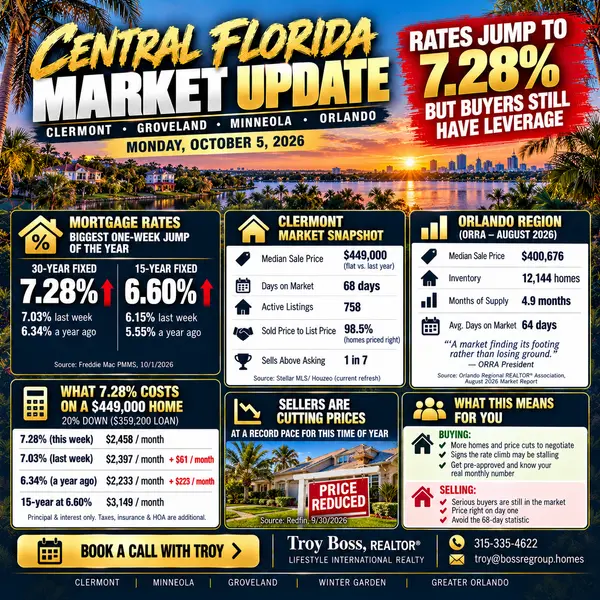
The tax is one piece. Rates are higher than a year ago, but homes are also taking about two months to sell, so buyers have more room to negotiate than in recent years. I cover the full picture in the relocation guide, and next Thursday I'll go through homeowners insurance in detail. For the fees that come with newer communities, see my explainer on HOA and CDD fees in Clermont.
Want your own numbers? I'll walk you through your budget, your towns and your timeline in 20 minutes, with no pressure, and I'll point you to the right people for the tax questions.
Book a free 20-minute relocation call
Troy Boss
REALTOR® – LIFESTYLE International Realty, Clermont
315-335-4622 · tboss@bossregroup.com
Sources: Tax Foundation, State Individual Income Tax Rates and Brackets, 2026 (top and flat rates as of January 1, 2026; local taxes excluded). Federal SALT deduction cap for 2026 under the One Big Beautiful Bill Act. Illustrations are rough, use flat rates on $200,000 of taxable income before exemptions, credits and local taxes, and are not a prediction of your result. This guide is general information, not tax, legal or insurance advice. Confirm your own numbers with your CPA, attorney, lender and insurance agent.
Recent Posts








"My job is to find and attract mastery-based agents to the office, protect the culture, and make sure everyone is happy! "