
Florida Property Taxes for Buyers: Reassessment, Homestead and the November Ballot
 If you're moving to Florida, the property tax bill is one of the most misunderstood costs, and it is the one that most often surprises buyers after closing. I'm Troy Boss, a REALTOR® with LIFESTYLE International Realty in Clermont. This is the plain-English version of how it works and what to check before you make an offer. I'm not a tax professional or an attorney, so confirm the details for your situation with the county property appraiser and your CPA.
How are Florida property taxes calculated?
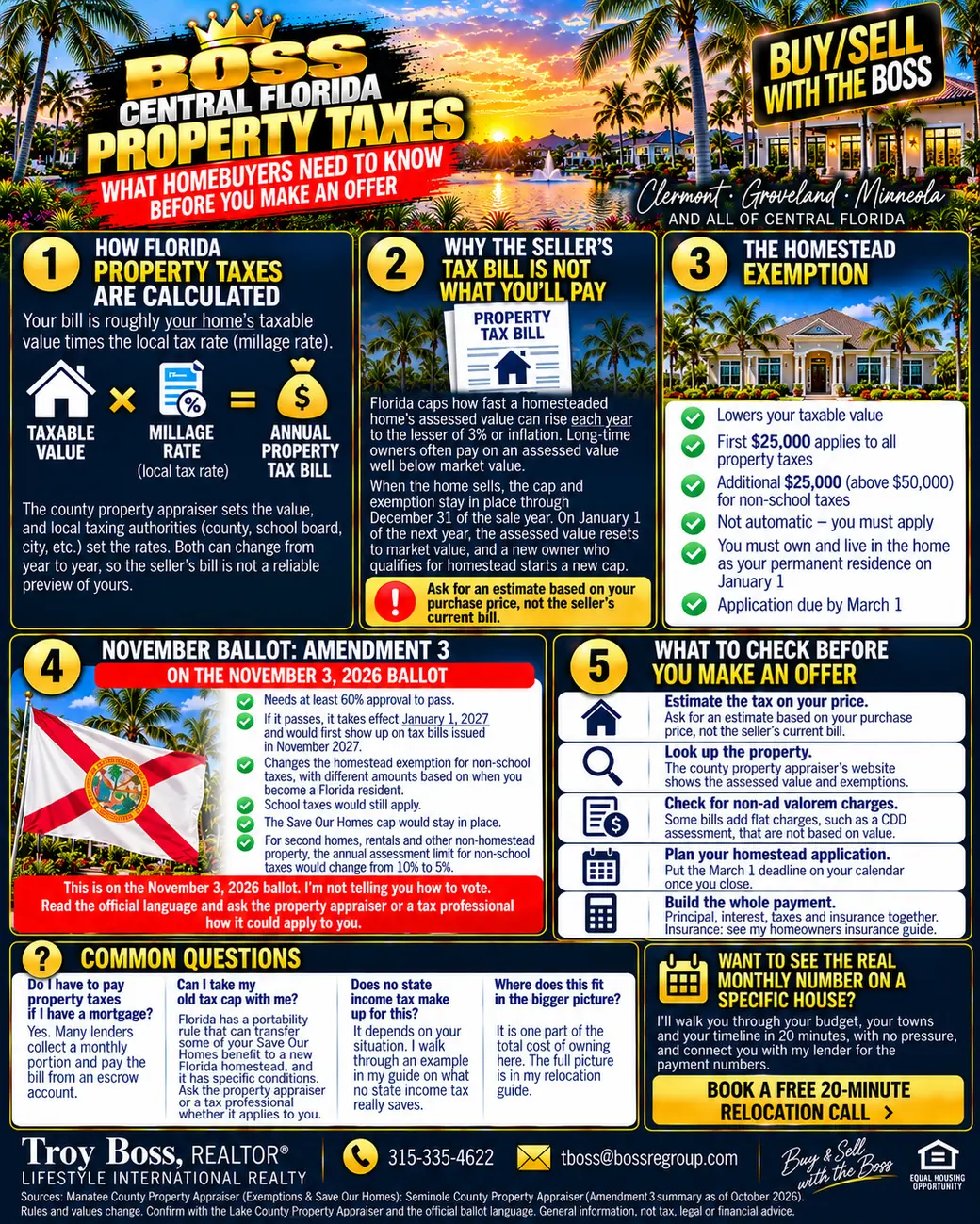
Your bill is roughly your home's taxable value times the local tax rate, called the millage rate. The county property appraiser sets the value, and local taxing authorities, such as the county, the school board and the city, set the rates. Both change from year to year, so the seller's bill is not a reliable preview of yours.
Why does the seller's tax bill not tell me what I'll pay?
This is the big one. Florida caps how fast a homesteaded home's assessed value can rise each year, to the lesser of 3% or inflation. Long-time owners often pay on an assessed value well below what the home would sell for. When the home sells, the cap and the exemption stay in place through December 31 of the sale year. Starting January 1 of the next year, the assessed value resets to market value, and a new owner who qualifies for homestead starts a new cap from there. So the bill you see in the listing can be much lower than your first full bill.
Ask your agent and your lender to estimate the tax on the price you're paying, not on the seller's current bill.
What is the homestead exemption?
If the home is your permanent Florida residence, you can claim a homestead exemption that lowers its taxable value. As the county property appraisers describe it, the first $25,000 applies to all property taxes. An additional exemption of up to $25,000 applies to value above $50,000 and does not apply to school taxes. It is not automatic, so you must apply with the county property appraiser. You need to own the home and live in it as your permanent residence on January 1, and the application is due by March 1. A buyer who closes this year generally has to apply by March 1 of the following year to start the exemption on their own bill.
What is on the November ballot?
Florida voters will see a property tax amendment, Amendment 3, on the November 3, 2026 ballot. I'm not telling you how to vote. Here is what the county property appraisers say it would do, so you can read the official language yourself:
- It needs at least 60% approval to pass.
- If it passes, it takes effect January 1, 2027, and would first show up on tax bills issued in November 2027.
- It would change the homestead exemption for non-school taxes, with amounts that differ based on when you became a Florida resident. People who become residents on or after January 1, 2027 start with a smaller amount than existing residents.
- School taxes would still apply.
- The Save Our Homes cap would stay in place.
- For second homes, rentals and other non-homestead property, the annual assessment limit for non-school taxes would change from 10% to 5%.
If you're buying soon, ask the property appraiser or a tax professional how it could apply to you, and don't build your budget on an outcome nobody knows yet.
What should I check before I make an offer?
- Estimate the tax on your price. Ask for an estimate based on your purchase price, not the seller's current bill.
- Look up the property. The county property appraiser's website shows the assessed value, exemptions and recent tax bills for any address.
- Check for non-ad valorem charges. Some bills add flat charges, such as a CDD assessment, that are not based on value. I cover those in my guide on HOA and CDD fees in Clermont.
- Plan your homestead application. Put the March 1 deadline on your calendar once you close.
- Build the whole payment. Principal, interest, taxes and insurance together. My guide on Florida homeowners insurance covers the insurance side.
Common questions
Do I have to pay property taxes if I have a mortgage?
Yes, but many lenders collect a monthly portion with your payment and pay the bill from an escrow account. Ask your lender how yours will work.
Can I take my old tax cap with me?
Florida has a portability rule that can transfer some of your accumulated Save Our Homes benefit to a new Florida homestead, and it has specific conditions. Ask the property appraiser or a tax professional whether it applies to you.
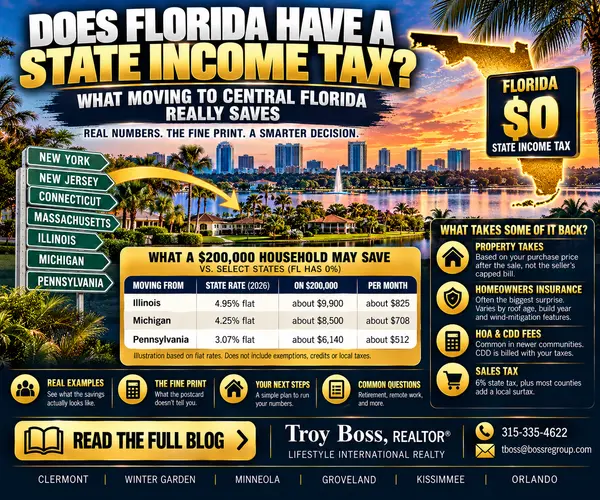
Does no state income tax make up for this?
It depends on your situation. I walk through an example in my guide on what no state income tax really saves.
Where does this fit in the bigger picture?
It is one part of the total cost of owning here. The full picture is in my relocation guide.
Want to see the real monthly number on a specific house? I'll walk you through your budget, your towns and your timeline in 20 minutes, with no pressure, and connect you with my lender for the payment numbers.
Book a free 20-minute relocation call
Troy Boss
REALTOR® – LIFESTYLE International Realty, Clermont
315-335-4622 · tboss@bossregroup.com
Sources: Manatee County Property Appraiser, Exemptions & Save Our Homes (homestead exemption amounts, 3% or CPI cap, reassessment after sale, March 1 deadline); Seminole County Property Appraiser, property tax initiative page (Amendment 3 summary as of October 2026). Rules, values and ballot measures change; confirm current figures with the Lake County Property Appraiser and the official ballot language. This guide is general information, not tax, legal or financial advice. Confirm your situation with a CPA or Florida real estate attorney.
Recent Posts






"My job is to find and attract mastery-based agents to the office, protect the culture, and make sure everyone is happy! "